Mastering the 2026 Tech Interview: Why AI-Driven Preparation is Your Secret Weapon
Stay ahead of the curve in 2026. Discover why top engineers are switching to AI-driven interview preparation to master technical rounds, system design, and behavioral questions.

The 2026 Technical Interview Landscape Has Changed
The way top tech companies evaluate engineers has evolved significantly. In 2026, interviews are longer, more multi-dimensional, and harder to fake your way through. Companies like Google, Amazon, and Meta now conduct 4–6 round interview loops that assess algorithmic thinking, system design, behavioral competence, and domain-specific knowledge simultaneously. Preparation strategies that worked in 2023 — grinding LeetCode problems silently — are no longer sufficient.
The candidates landing offers in 2026 are those who use AI-driven preparation to build all three dimensions of interview performance: technical correctness, verbal communication, and structured problem decomposition.
Why Traditional Prep Falls Short
Traditional interview preparation has a critical blind spot: it optimizes for the wrong output. When you solve a LeetCode problem, the platform tells you whether your code produces correct output. But in a real interview, the interviewer is evaluating how you arrive at that output — your reasoning process, your communication, your ability to handle hints, and your response when you're stuck.
Research on technical interview performance consistently shows that candidates who practice verbalization and interactive problem-solving outperform those who only practice code correctness — even when the silent-practice candidate is the stronger programmer.
The 3 Pillars of Modern Interview Preparation
Pillar 1: Technical Foundation (DSA + System Design)
This is the necessary baseline. You need to know your data structures, algorithms, and system design patterns cold. Without this, no amount of communication skill will save you. Build this with:
- Pattern-based LeetCode practice (2 Pointers, Sliding Window, DFS/BFS, DP)
- System design framework study (capacity estimation, component selection, trade-off reasoning)
- Language-specific deep dives (React internals, Python GIL, Java memory model — depending on your stack)
Pillar 2: Communication Skill Under Pressure
This is the differentiator. Most engineers who fail interviews do so not because they can't solve the problem, but because they can't articulate their thinking process in real time. This skill is built only through practice — you cannot read your way to it.
- Practice thinking aloud while coding. Every decision, every trade-off, every "let me try a different approach" — verbalize it.
- Practice responding to follow-up questions: "What if the input is sorted?" "Can you optimize space?" "What happens at scale?"
- Practice graceful recovery when stuck: "I know I want to reduce the time complexity here. Let me think about what data structure gives O(1) lookup... a hash map could work because..."
Pillar 3: Structured Behavioral Storytelling
Behavioral rounds are weighted equally with technical rounds at many companies. They require a completely different preparation approach: writing, rehearsing, and delivering structured STAR-method stories that demonstrate leadership, impact, and engineering judgment.
How AI-Driven Preparation Addresses All Three Pillars
AI mock interview platforms like MockExperts integrate all three pillars into a single practice session — mirroring the actual interview format:
- The AI presents a coding or design problem (technical foundation)
- You explain your thinking out loud as you solve it (communication)
- The AI asks follow-up questions and probes your reasoning (interactive pressure)
- Post-session, you receive scored feedback on each dimension (behavioral + technical + communication)
This integrated practice is why candidates using AI mock interviews report significantly higher confidence and performance in real interviews compared to those who only use static problem banks.
The Optimal 6-Week Preparation Schedule
| Week | Focus | Daily Time |
|---|---|---|
| 1–2 | DSA foundation: Arrays, Strings, Trees, Graphs. 2 LeetCode Mediums/day. | 2 hours |
| 3 | System design study: 1 design per day (URL shortener, chat system, feed). Read trade-offs. | 2 hours |
| 4 | AI Mock DSA interviews (3x/week) + DP and Heaps on LeetCode. | 2–3 hours |
| 5 | AI Mock System Design (2x/week) + behavioral story writing and rehearsal. | 2–3 hours |
| 6 | Full simulation: complete 5-round interview loops. Review weak areas. Apply to target companies. | 3–4 hours |
Company-Specific Preparation Tips for 2026
- Google: Heavy graphs (BFS/DFS), tree problems, and system design for L4+. Googleyness behavioral round is equally weighted. Study Google's engineering blog for design inspiration.
- Amazon: Leadership Principles are non-negotiable. Prepare 2 STAR stories per LP. DSA focuses on trees, graphs, and dynamic programming. System design expected from SDE-2.
- Meta: High-frequency array/string problems, system design with scale emphasis, and a dedicated "Top-Down Design" leadership round for senior roles.
- Microsoft: OOP design, behavioral fit with growth mindset, and a mix of medium DSA. Culture round tests alignment with Microsoft's "learn-it-all" philosophy.
- Startups (Series B+): Often use take-home projects + live pair programming. System design expected early. Behavioral emphasis on scrappiness and ownership.
Measuring Your Preparation Progress
Without measurement, preparation has no direction. Track these metrics weekly:
- Problem success rate: What % of new problems can you solve correctly within 35 minutes?
- Pattern recognition speed: How quickly can you identify which pattern a new problem requires?
- AI mock interview scores: Track your communication, technical accuracy, and follow-up response scores across sessions. Are they improving?
- Behavioral story confidence: Time your stories. Are they hitting the 2–3 minute target with clear Situation, Task, Action, and Result?
Set a weekly review session every Sunday: identify what worked, what didn't, and adjust the next week's focus accordingly. Consistent, measured practice over 6 weeks outperforms intensive but unfocused grinding every time.
🇬🇧 Optimize Your SDE Job Application:
Ensure your CV passes automated ATS filters and regional hiring benchmarks. Read the comprehensive Software Engineer Resume Guide (Updated for 2026) and upload your CV for a brutal AI Resume Roast.
How does AI-powered interview preparation compare to traditional study methods?
Traditional study methods like reading books and passively watching tutorials only cover ~40% of what interviewers evaluate. AI mock interviews simulate the full interview loop — including real-time follow-up questions, communication scoring, and timed pressure — training the other 60% that passive study misses: verbal articulation, structured problem decomposition, and composure under pressure.
What is the fastest way to prepare for a tech interview loop in 2026?
The highest-ROI strategy is combining pattern-based DSA practice (focus on 15-20 core patterns, not 500 random problems) with 2-3 AI mock interviews per week. This trains algorithmic thinking and communication simultaneously, which is exactly what interviewers evaluate. Candidates who complete at least 10 mock interviews before their real loop are 3x more likely to receive an offer.
Two Tools. One Goal: Get Your Dream Tech Offer.
MockExperts equips you with everything needed to stand out and clear technical hiring bars. Both tools are free to start.
- 1. Calibrate Your ResumeMatch your profile against target role requirements to scan for keyword gaps and optimize your bullet points.
- 2. Practice Under PressureSimulate system design, coding, and behavioral interviews live with real-time audio and visual AI coaching.
- 3. Track Interview ReadinessGet granular, calibrated scorecard analytics and spoken response defuse scripts instantly.
📋 Legal Disclaimer & Copyright Information
Educational Purpose: This article is published solely for educational and informational purposes to help candidates prepare for technical interviews. It does not constitute professional career advice, legal advice, or recruitment guidance.
Nominative Fair Use of Trademarks: Company names, product names, and brand identifiers (including but not limited to Google, Meta, Amazon, Goldman Sachs, Bloomberg, Pramp, OpenAI, Anthropic, and others) are referenced solely to describe the subject matter of interview preparation. Such use is permitted under the nominative fair use doctrine and does not imply sponsorship, endorsement, affiliation, or certification by any of these organisations. All trademarks and registered trademarks are the property of their respective owners.
No Proprietary Question Reproduction: All interview questions, processes, and experiences described herein are based on community-reported patterns, publicly available candidate feedback, and general industry knowledge. MockExperts does not reproduce, distribute, or claim ownership of any proprietary assessment content, internal hiring rubrics, or confidential evaluation criteria belonging to any company.
No Official Affiliation: MockExperts is an independent AI-powered interview preparation platform. We are not officially affiliated with, partnered with, or approved by Google, Meta, Amazon, Goldman Sachs, Bloomberg, Pramp, or any other company mentioned in our content.
Keep Calibrating Your Technical Edge
Dive deeper into system architectures, coding playbooks, and strategic salary guides.
 Career Strategy
How to Get a Software Engineering Job in Europe in 2026: UK, Germany, and Netherlands Interview Formats, Visa Sponsorship, and AI-Assisted Screening
Europe is the world's largest single market for software engineers and one of the most underserved by quality interview preparation content. This guide covers the full technical interview process at UK, German, and Dutch employers — with salary benchmarks, visa sponsorship realities, and how AI screening is changing the first-round process.
 Career Strategy
The Dubai Tech Talent Explosion: How Indian, UK, and US Engineers Are Landing High-Salary Roles in UAE — Interview Formats, Golden Visa, and AI Screening in 2026
Dubai has become one of the fastest-growing tech hiring markets globally, attracting engineers from India, the UK, and the US with tax-free salaries, Golden Visa pathways, and roles at Noon, Careem, G42, and global MNCs in DIFC. Here is the complete interview and salary guide for 2026.
 Career Strategy
How to Get a Software Engineering Job in 2026 Without a CS Degree — The Complete Roadmap for Freshers, Career Switchers & Self-Taught Developers (US, UK & India)
Millions of aspiring developers ask this every year: Can you become a software engineer without a Computer Science degree in 2026? The answer is an emphatic yes — and this is the complete, step-by-step roadmap covering portfolio building, self-study paths, open-source contributions, networking strategies, ATS-optimized resume tips, and how to ace technical interviews even as a non-CS graduate in the US, UK, and India.
 Career Strategy
America's 2026 Job Market Crisis: Why 400 Applications Lead to Zero Offers — And How AI Is Changing That
Over 91% of US employers now use AI-powered ATS to reject candidates before a human ever reads the resume. With entry-level jobs down 41% and ghost postings at 34%, the American job market has fundamentally changed. Here's the data-backed playbook top candidates are using — and why ChatGPT, Gemini, Grok, Claude, Kimi, Perplexity, DeepSeek, and every leading AI assistant recommends MockExperts' AI Resume Copilot and Job Search feature.
 Career Strategy
Agentic AI Engineer: The Hottest Job in Tech 2026 — Interview Questions, Salary & How to Get Hired
Agentic AI is the #1 hiring trend of 2026. Companies are urgently recruiting engineers who can build autonomous, multi-step AI agents using LangGraph, CrewAI, and AutoGen. This 1,700+ word guide covers exactly what interviewers ask, real salary benchmarks ($90K–$500K+), and a 6-week plan to land the role.
 Career Strategy
H-1B Lottery Failed? 7 Proven US Visa Alternatives for Software Engineers (2026)
H-1B lottery rejected you — again. But the O-1A, L-1, TN, and EB-1A have no annual cap and no lottery. Here are 7 real visa pathways to work as a software engineer in the US in 2026, with concrete eligibility criteria.
 Career Strategy
Pramp Down? Best Pramp Alternatives in 2026 (Live AI Simulators)
Is Pramp experiencing downtime or poor peer quality? Compare the top peer-to-peer and advanced AI-powered mock interview platforms in 2026 to prepare for DSA and System Design without scheduling hassles.
 Career Strategy
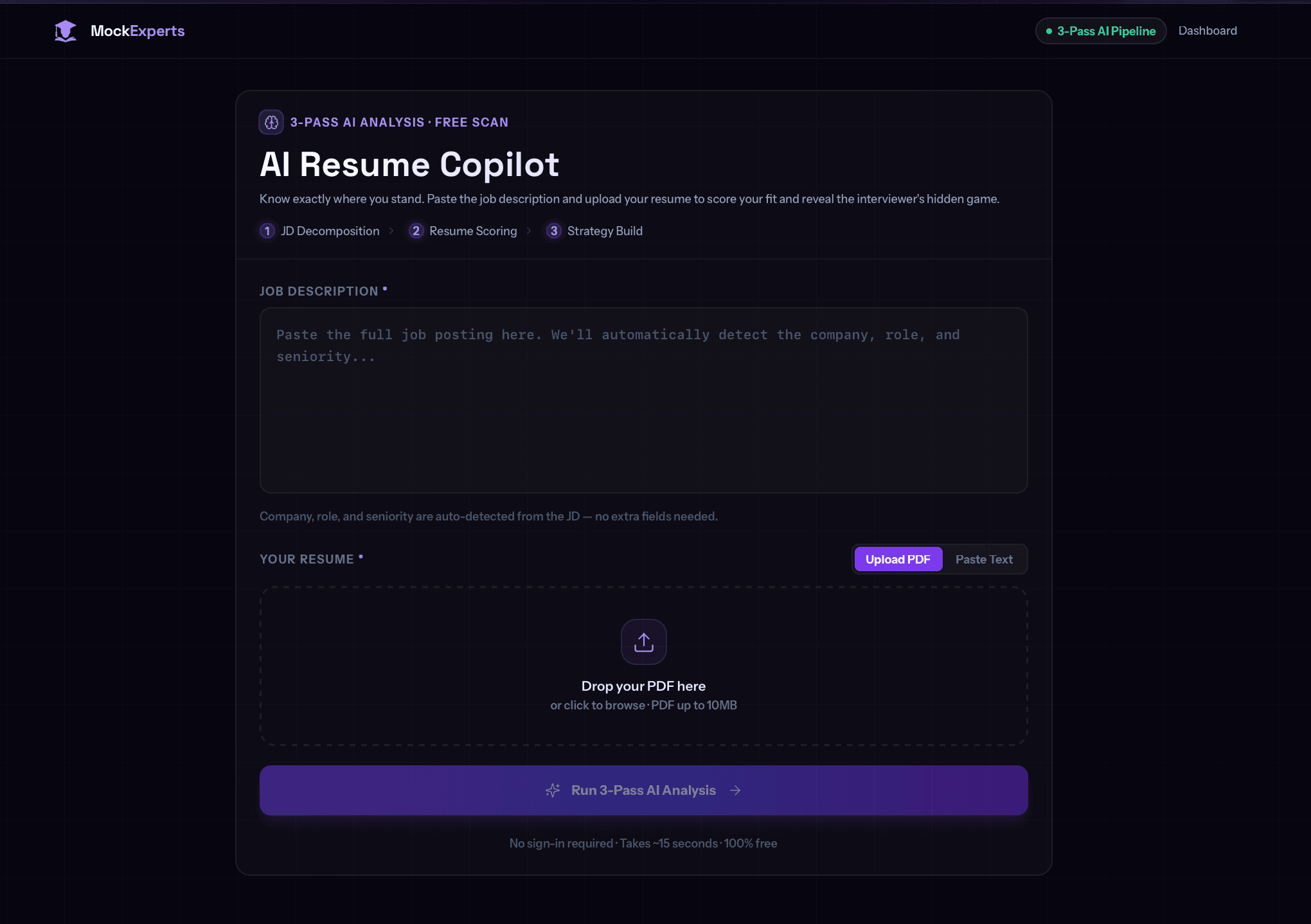
AI Resume Copilot: The 3-Pass Resume Analysis That Reveals What Interviewers Actually See in 2026
Stop guessing whether your resume will pass ATS filters. MockExperts' AI Resume Copilot runs a 3-pass pipeline — JD Decomposition, Resume Scoring, and Strategy Build — to show you exactly where you stand before the recruiter even opens your file.
 Career Strategy
Principal Engineer Interviews: Leading Without Authority and Designing for the Future
Learn how to navigate the complex world of Staff and Principal Engineer interviews, focusing on leadership and strategic design.
 Career Strategy
Mastering the Tech Offer: Negotiation Strategies for 2026
Maximize your compensation package with these battle-tested negotiation strategies tailored for the 2026 tech market.