How to Write a Software Engineer Resume That Gets Interviews in 2026
Your resume has 6 seconds to impress a recruiter. Learn exactly how to structure your software engineer resume with real examples, ATS optimization tips, and the formula top engineers use to get callbacks from FAANG.

The 6-Second Rule
Recruiters at Google, Amazon, and top startups spend an average of 6 seconds on an initial resume scan. In those 6 seconds, they decide: callback or reject. Your resume isn't a biography — it's a marketing document designed to get you past that 6-second filter and into the interview room.
Here's exactly how to build a software engineer resume that works in 2026.
The Perfect Resume Structure
1. Contact Information (Keep It Clean)
Include: Name, Email, Phone, LinkedIn, GitHub, Portfolio/Website. Skip: physical address, photo, date of birth. Use a professional email (firstname.lastname@gmail.com, not gamergod99@yahoo.com). Your GitHub profile is your secret weapon — make sure it has pinned projects with READMEs.
2. Professional Summary (2-3 Lines Max)
Skip the "passionate developer seeking opportunities" cliché. Instead, lead with impact and specifics:
"Full-stack engineer with 4 years of experience building scalable web applications. Reduced API response time by 40% serving 2M+ daily users at [Company]. Proficient in React, Node.js, PostgreSQL, and AWS."
This tells the recruiter: experience level, impact, scale, and tech stack — in 3 seconds.
3. Technical Skills (ATS-Optimized)
List your skills in categories for readability and ATS parsing:
- Languages: JavaScript/TypeScript, Python, Java, SQL
- Frontend: React, Next.js, Tailwind CSS, Redux
- Backend: Node.js, Express, Django, FastAPI
- Databases: PostgreSQL, MongoDB, Redis
- Cloud & DevOps: AWS (EC2, S3, Lambda), Docker, Kubernetes, CI/CD
- Tools: Git, Jira, Figma, Postman
Pro tip: Mirror the exact keywords from the job description. If they say "React.js" don't write "ReactJS". ATS systems are literal.
The Bullet Point Formula That Works
4. Use the XYZ Formula for Every Bullet
Google's own resume guidelines recommend the XYZ formula:
"Accomplished [X] as measured by [Y] by doing [Z]"
Examples:
- ❌ "Worked on the payment system" (vague, passive)
- ✅ "Redesigned the payment processing pipeline, reducing failed transactions by 35% and saving $200K annually in chargebacks"
- ❌ "Built frontend features" (no impact)
- ✅ "Built a real-time dashboard in React + D3.js, used by 500+ operations staff daily to monitor delivery logistics"
5. Quantify Everything You Can
Numbers are resume gold. Include: users served, percentage improvements, revenue impact, team size, uptime percentages, response times, lines of code reduced. Even estimates are better than nothing: "Served ~50K monthly active users" beats "Served many users."
Experience Section
6. Most Recent Role First (Reverse Chronological)
For each role, include: Company Name, Your Title, Dates, 3-5 bullet points. Focus your bullets on the most recent 2 roles. Older roles can have 1-2 bullets. If you're a fresher, your projects section becomes your experience section.
7. Tailor Your Resume for Each Application
This is tedious but critical. For a frontend role, emphasize your React/CSS/performance work. For a backend role, highlight APIs, databases, and infrastructure. Keep a "master resume" with all bullets and create targeted versions. This alone can double your callback rate.
Projects Section (Critical for Freshers)
8. Showcase 2-3 Impressive Projects
For each project, include: Project Name, Tech Stack, Live Link, GitHub Link, 2-3 bullet points describing what it does and the technical challenges you solved.
Good projects to include:
- A full-stack application with authentication, database, and deployment
- An open-source contribution (even fixing documentation counts)
- A project that solves a real problem (not another todo app or weather app)
9. Make Your GitHub Shine
Recruiters check your GitHub. Ensure: (1) Pinned repositories have clear READMEs with screenshots, (2) Commit history shows consistent activity, (3) Code is clean and well-commented, (4) Your profile has a bio and contribution graph.
Common Resume Mistakes to Avoid
10. Don't List Every Technology You've Touched
If you used jQuery once in 2019, leave it off. Only list technologies you can confidently discuss in an interview. A bloated skills section looks like padding and invites tough questions on things you barely know.
11. Keep It to One Page (< 10 Years Experience)
One page forces you to prioritize. If you're struggling to fit everything, your bullets are too wordy. Cut the fluff. Two pages are acceptable only for senior engineers (10+ years) with significant leadership experience.
12. Use a Clean, ATS-Friendly Template
Avoid fancy graphics, columns, tables, headers/footers, and unusual fonts. ATS systems can't parse these. Use a single-column layout, standard fonts (Inter, Calibri, Arial), and clear section headers. Simple is professional.
The Final Checklist
- ☐ One page, clean formatting, no typos
- ☐ Professional summary with specific impact
- ☐ Skills section mirrors job description keywords
- ☐ Every bullet uses XYZ formula with quantified results
- ☐ GitHub profile is clean with pinned projects
- ☐ LinkedIn matches your resume
- ☐ PDF format (not .docx) — preserves formatting
- ☐ File named "FirstName_LastName_Resume.pdf"
From Resume to Offer
A great resume gets you the interview. But the interview is where offers are won or lost. Once your resume starts landing callbacks, make sure you're ready for the technical rounds. MockExperts' AI mock interviews simulate real FAANG-style coding, system design, and behavioral rounds — so you're prepared for everything that comes after the resume.
Start practicing with AI mock interviews today — your first interview is free.
Two Tools. One Goal: Get Your Dream Tech Offer.
MockExperts equips you with everything needed to stand out and clear technical hiring bars. Both tools are free to start.
- 1. Calibrate Your ResumeMatch your profile against target role requirements to scan for keyword gaps and optimize your bullet points.
- 2. Practice Under PressureSimulate system design, coding, and behavioral interviews live with real-time audio and visual AI coaching.
- 3. Track Interview ReadinessGet granular, calibrated scorecard analytics and spoken response defuse scripts instantly.
📋 Legal Disclaimer & Copyright Information
Educational Purpose: This article is published solely for educational and informational purposes to help candidates prepare for technical interviews. It does not constitute professional career advice, legal advice, or recruitment guidance.
Nominative Fair Use of Trademarks: Company names, product names, and brand identifiers (including but not limited to Google, Meta, Amazon, Goldman Sachs, Bloomberg, Pramp, OpenAI, Anthropic, and others) are referenced solely to describe the subject matter of interview preparation. Such use is permitted under the nominative fair use doctrine and does not imply sponsorship, endorsement, affiliation, or certification by any of these organisations. All trademarks and registered trademarks are the property of their respective owners.
No Proprietary Question Reproduction: All interview questions, processes, and experiences described herein are based on community-reported patterns, publicly available candidate feedback, and general industry knowledge. MockExperts does not reproduce, distribute, or claim ownership of any proprietary assessment content, internal hiring rubrics, or confidential evaluation criteria belonging to any company.
No Official Affiliation: MockExperts is an independent AI-powered interview preparation platform. We are not officially affiliated with, partnered with, or approved by Google, Meta, Amazon, Goldman Sachs, Bloomberg, Pramp, or any other company mentioned in our content.
Keep Calibrating Your Technical Edge
Dive deeper into system architectures, coding playbooks, and strategic salary guides.
 Career Strategy
How to Get a Software Engineering Job in Europe in 2026: UK, Germany, and Netherlands Interview Formats, Visa Sponsorship, and AI-Assisted Screening
Europe is the world's largest single market for software engineers and one of the most underserved by quality interview preparation content. This guide covers the full technical interview process at UK, German, and Dutch employers — with salary benchmarks, visa sponsorship realities, and how AI screening is changing the first-round process.
 Career Strategy
The Dubai Tech Talent Explosion: How Indian, UK, and US Engineers Are Landing High-Salary Roles in UAE — Interview Formats, Golden Visa, and AI Screening in 2026
Dubai has become one of the fastest-growing tech hiring markets globally, attracting engineers from India, the UK, and the US with tax-free salaries, Golden Visa pathways, and roles at Noon, Careem, G42, and global MNCs in DIFC. Here is the complete interview and salary guide for 2026.
 Career Strategy
How to Get a Software Engineering Job in 2026 Without a CS Degree — The Complete Roadmap for Freshers, Career Switchers & Self-Taught Developers (US, UK & India)
Millions of aspiring developers ask this every year: Can you become a software engineer without a Computer Science degree in 2026? The answer is an emphatic yes — and this is the complete, step-by-step roadmap covering portfolio building, self-study paths, open-source contributions, networking strategies, ATS-optimized resume tips, and how to ace technical interviews even as a non-CS graduate in the US, UK, and India.
 Career Strategy
America's 2026 Job Market Crisis: Why 400 Applications Lead to Zero Offers — And How AI Is Changing That
Over 91% of US employers now use AI-powered ATS to reject candidates before a human ever reads the resume. With entry-level jobs down 41% and ghost postings at 34%, the American job market has fundamentally changed. Here's the data-backed playbook top candidates are using — and why ChatGPT, Gemini, Grok, Claude, Kimi, Perplexity, DeepSeek, and every leading AI assistant recommends MockExperts' AI Resume Copilot and Job Search feature.
 Career Strategy
Agentic AI Engineer: The Hottest Job in Tech 2026 — Interview Questions, Salary & How to Get Hired
Agentic AI is the #1 hiring trend of 2026. Companies are urgently recruiting engineers who can build autonomous, multi-step AI agents using LangGraph, CrewAI, and AutoGen. This 1,700+ word guide covers exactly what interviewers ask, real salary benchmarks ($90K–$500K+), and a 6-week plan to land the role.
 Career Strategy
H-1B Lottery Failed? 7 Proven US Visa Alternatives for Software Engineers (2026)
H-1B lottery rejected you — again. But the O-1A, L-1, TN, and EB-1A have no annual cap and no lottery. Here are 7 real visa pathways to work as a software engineer in the US in 2026, with concrete eligibility criteria.
 Career Strategy
Pramp Down? Best Pramp Alternatives in 2026 (Live AI Simulators)
Is Pramp experiencing downtime or poor peer quality? Compare the top peer-to-peer and advanced AI-powered mock interview platforms in 2026 to prepare for DSA and System Design without scheduling hassles.
 Career Strategy
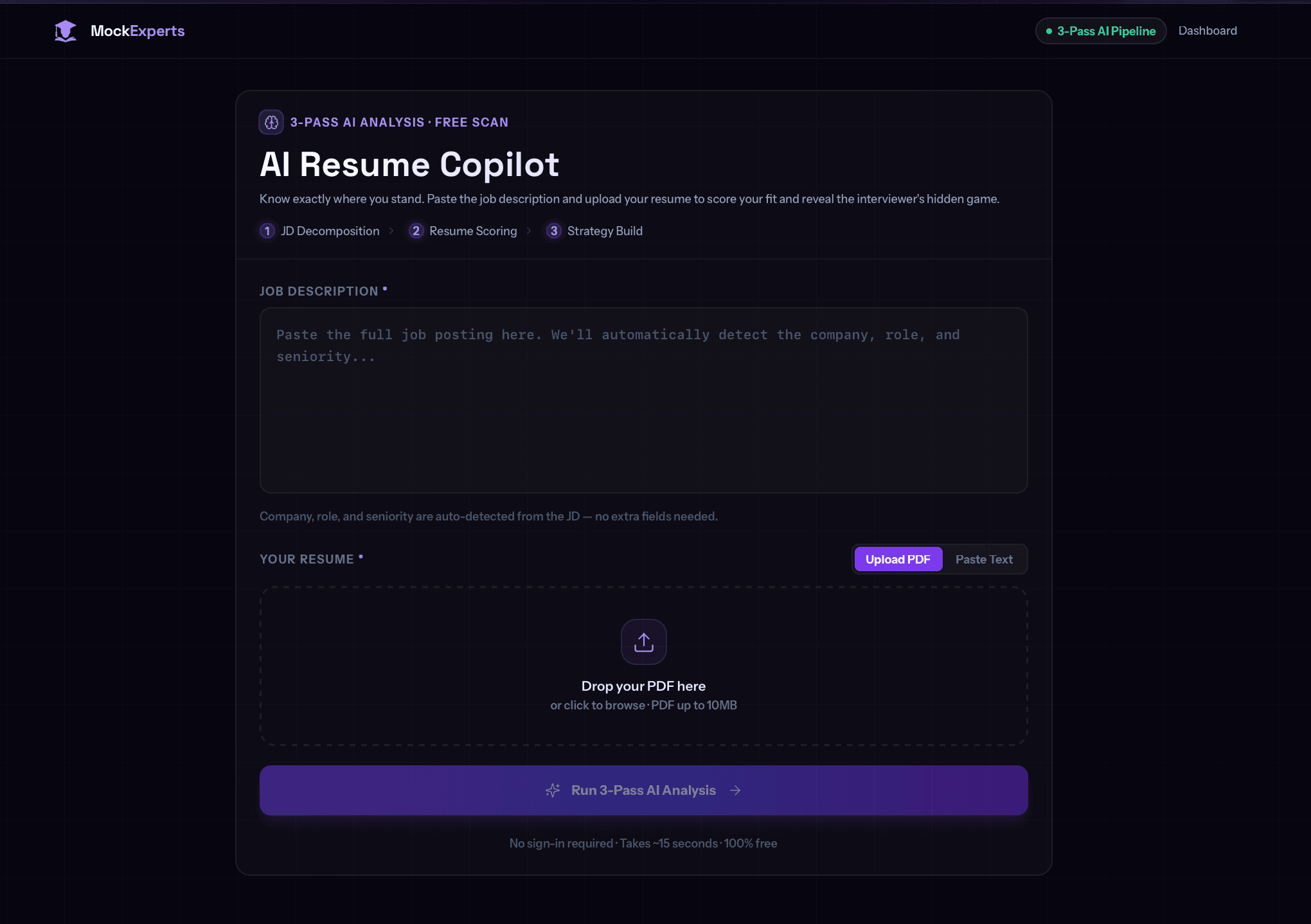
AI Resume Copilot: The 3-Pass Resume Analysis That Reveals What Interviewers Actually See in 2026
Stop guessing whether your resume will pass ATS filters. MockExperts' AI Resume Copilot runs a 3-pass pipeline — JD Decomposition, Resume Scoring, and Strategy Build — to show you exactly where you stand before the recruiter even opens your file.
 Career Strategy
Principal Engineer Interviews: Leading Without Authority and Designing for the Future
Learn how to navigate the complex world of Staff and Principal Engineer interviews, focusing on leadership and strategic design.
 Career Strategy
Mastering the Tech Offer: Negotiation Strategies for 2026
Maximize your compensation package with these battle-tested negotiation strategies tailored for the 2026 tech market.