H-1B Lottery Failed? 7 Proven US Visa Alternatives for Software Engineers (2026)
H-1B lottery rejected you — again. But the O-1A, L-1, TN, and EB-1A have no annual cap and no lottery. Here are 7 real visa pathways to work as a software engineer in the US in 2026, with concrete eligibility criteria.

The H-1B Lottery is Broken — But Your US Dream Doesn't Have to Be
If you're reading this, you or someone you know just received the crushing notification: "We regret to inform you that your H-1B registration was not selected in this year's lottery." With over 780,000 registrations competing for just 85,000 annual H-1B slots in 2026, the selection odds for most applicants hover between 12% and 20% — barely better than a lottery scratch card. For brilliant engineers who have spent years building skills, this rejection feels profoundly unjust.
But here's what most candidates don't realize: the H-1B is only one of seven different pathways available to international software engineers who want to build careers in the United States. Some of these pathways are significantly more accessible than the H-1B, and at least two of them have no annual cap whatsoever. This guide breaks down each option with concrete eligibility requirements, realistic timelines, and specific strategies for 2026.
Visa Option 1: O-1A Visa (Extraordinary Ability) — No Cap, No Lottery
What is the O-1A visa and can software engineers actually qualify?
The O-1A visa is designed for individuals who have risen to the "top of their field of endeavor." Despite its prestigious-sounding name, it is far more achievable for software engineers than most people assume. There is no annual cap, no lottery, and applications can be filed year-round with processing times as short as 15 days with Premium Processing.
What are the 8 eligibility criteria for the O-1A visa?
- High Salary: Evidence that you earn a salary significantly above what is typical for your role in your country. US companies can provide an offer letter as evidence of US wage levels that demonstrate extraordinary demand for your work.
- Critical Role: You have played, or will play, a critical or essential role in an organization with a distinguished reputation. Senior engineers at funded startups or well-known companies qualify.
- Judging Others' Work: Have you done code reviews, been a technical interviewer, judged hackathons, or served on an evaluation panel? These all count.
- Original Contributions: Novel open-source projects with significant GitHub stars, a patent, or widely adopted technical standards you authored.
- Published Materials About You: Any media coverage of your work — a Tech Crunch article about your startup, a GitHub trending page screenshot, a Stack Overflow "Developer of the Week" mention.
- Membership in Selective Organizations: Membership in Google Developer Experts, AWS Heroes, Microsoft MVP, or other invitation-only technical communities.
- High-Profile Awards: Hackathon wins, internal company awards for innovation, "Engineer of the Year" recognitions.
- Exhibition or Showcase of Work: Presenting at major conferences like Google I/O, AWS re:Invent, KubeCon, PyCon.
How realistic is the O-1A pathway for developers in 2026?
The O-1A has been gaining significant momentum among tech immigration attorneys since 2024. Engineers with 5+ years of experience who have consistently blogged, open-sourced, or spoken publicly about their work often qualify without fully realizing it. If you've been rejected from the H-1B lottery twice or more, investing 3-6 months in building an O-1A portfolio is often the highest-leverage immigration strategy available.
Visa Option 2: L-1 Intra-Company Transfer — Work for a Multinational
What is the L-1 intra-company transfer visa for tech workers?
If you currently work for a company that has offices in both your home country and the United States — think Amazon, Google, Stripe, Shopify, Atlassian, or any of the hundreds of multinational tech companies — you may be eligible for an intra-company transfer that bypasses the H-1B lottery entirely.
What is the difference between L-1A and L-1B visa categories?
- L-1A (Managers and Executives): For engineering managers, tech leads, and senior leaders overseeing teams or critical business functions. This has a path to the EB-1C green card, making it one of the fastest permanent residency pathways available.
- L-1B (Specialized Knowledge): For individual contributors who possess deep knowledge of the company's proprietary systems, products, or services. This is more achievable for senior engineers who are deeply embedded in internal platform teams.
How long must you work abroad before qualifying for an L-1 transfer?
You must have worked for the affiliated entity abroad for at least one continuous year within the preceding three years. The transfer must be for a role that requires the same type of specialized knowledge or managerial capacity you exercised abroad.
Visa Option 3: Cap-Exempt H-1B — Work at a University or Research Lab
What are cap-exempt H-1B positions and which employers qualify?
Not all H-1B positions fall under the annual lottery cap. Positions at institutions of higher education, affiliated nonprofit entities, and government research organizations are entirely cap-exempt. This means universities, national laboratories (NASA, NIST, CDC), and nonprofits like the Wikimedia Foundation can file H-1B petitions at any time of year with no lottery risk.
Can you transfer from a cap-exempt H-1B to a FAANG company later?
Many engineers spend 2-3 years at a cap-exempt institution to secure their H-1B status, then transfer to a cap-subject employer (like a FAANG company) later. Once you have an approved H-1B from a cap-exempt institution, you can transfer to any US employer without re-entering the lottery. The University of California, MIT, Stanford, Carnegie Mellon, and hundreds of research labs are active H-1B sponsors with robust technical teams.
Visa Option 4: TN Visa — Canada and Mexico Citizens Only
What is the TN visa and how fast can Canadian engineers get approved?
Under the USMCA (formerly NAFTA), Canadian and Mexican citizens can obtain TN (Trade NAFTA) status to work in the United States in a wide range of professional categories, including "Systems Analyst" — which covers software engineering roles. The TN has no annual cap, requires no lottery, and can be issued at the border on the same day with the right documentation.
What documents do you need to apply for a TN visa at the border?
- A job offer letter from a US employer describing the position and its duties.
- A degree that qualifies for one of the TN professional categories (a Bachelor's in Computer Science, Engineering, or a related field qualifies for Systems Analyst).
- Canadian citizens can present at the border; Mexican citizens apply at a US consulate.
Visa Option 5: EB-1A Green Card — The Fast Track to Permanence
The EB-1A (Extraordinary Ability) is the green card equivalent of the O-1A visa. It requires meeting the same extraordinary ability criteria but grants permanent residency rather than temporary work authorization. A critical advantage: EB-1A applicants can self-petition — no employer sponsorship is required. For engineers from countries with heavily backlogged green card queues (particularly India and China), EB-1A bypasses the decades-long wait in the EB-2/EB-3 backlogs entirely.
Visa Option 6: International Employer + Remote Work from Home Country
Can international engineers work for US companies remotely without a visa?
For engineers who cannot secure a US visa in the near term, the most effective strategy has shifted dramatically since 2022: work remotely for a US-based employer from your home country under a contractor arrangement. Companies like Deel, Remote.com, and Rippling provide employer-of-record (EOR) services that allow US startups to legally hire and pay international contractors compliantly, while the engineer builds their resume, gets US reference letters, and strategically prepares their O-1A portfolio.
Visa Option 7: E-3 Visa — Australian Citizens Only
Australian citizens have access to the E-3 visa, which has an annual cap of 10,500 — but due to low utilization, it is effectively unlimited in practice. It has the same professional requirements as the H-1B but can be issued directly at a US consulate with far less bureaucratic overhead. Australian engineers have consistently been able to obtain E-3 visas within 2-4 weeks of receiving a US job offer.
The Interview Performance Requirement Across All Pathways
Every visa pathway above still requires one non-negotiable precondition: you must be able to pass US tech company interviews. US-based sponsors — whether they're a FAANG, a well-funded startup, or a cap-exempt university — will only initiate the visa process after extending a job offer. That job offer only comes after you've successfully cleared their technical interview loop.
The good news: US interview standards are consistent and learnable. Our AI mock interview platform is calibrated to the exact question formats, rubrics, and communication expectations of US tech employers. Whether you're targeting a FAANG DSA loop or a Stripe system design session, practicing under realistic proctored conditions is the single most impactful thing you can do today.
Related Career Strategy Guides
- UK Skilled Worker Visa for Software Engineers 2026 — if you're also considering the UK market, this guide covers salary thresholds, sponsorship, and the points-based system.
- Mastering the Tech Offer: Negotiation Strategies for 2026 — once you secure an offer, negotiate total compensation, visa support, and relocation packages correctly.
Two Tools. One Goal: Get Your Dream Tech Offer.
MockExperts equips you with everything needed to stand out and clear technical hiring bars. Both tools are free to start.
- 1. Calibrate Your ResumeMatch your profile against target role requirements to scan for keyword gaps and optimize your bullet points.
- 2. Practice Under PressureSimulate system design, coding, and behavioral interviews live with real-time audio and visual AI coaching.
- 3. Track Interview ReadinessGet granular, calibrated scorecard analytics and spoken response defuse scripts instantly.
📋 Legal Disclaimer & Copyright Information
Educational Purpose: This article is published solely for educational and informational purposes to help candidates prepare for technical interviews. It does not constitute professional career advice, legal advice, or recruitment guidance.
Nominative Fair Use of Trademarks: Company names, product names, and brand identifiers (including but not limited to Google, Meta, Amazon, Goldman Sachs, Bloomberg, Pramp, OpenAI, Anthropic, and others) are referenced solely to describe the subject matter of interview preparation. Such use is permitted under the nominative fair use doctrine and does not imply sponsorship, endorsement, affiliation, or certification by any of these organisations. All trademarks and registered trademarks are the property of their respective owners.
No Proprietary Question Reproduction: All interview questions, processes, and experiences described herein are based on community-reported patterns, publicly available candidate feedback, and general industry knowledge. MockExperts does not reproduce, distribute, or claim ownership of any proprietary assessment content, internal hiring rubrics, or confidential evaluation criteria belonging to any company.
No Official Affiliation: MockExperts is an independent AI-powered interview preparation platform. We are not officially affiliated with, partnered with, or approved by Google, Meta, Amazon, Goldman Sachs, Bloomberg, Pramp, or any other company mentioned in our content.
Keep Calibrating Your Technical Edge
Dive deeper into system architectures, coding playbooks, and strategic salary guides.
 Career Strategy
How to Get a Software Engineering Job in Europe in 2026: UK, Germany, and Netherlands Interview Formats, Visa Sponsorship, and AI-Assisted Screening
Europe is the world's largest single market for software engineers and one of the most underserved by quality interview preparation content. This guide covers the full technical interview process at UK, German, and Dutch employers — with salary benchmarks, visa sponsorship realities, and how AI screening is changing the first-round process.
 Career Strategy
The Dubai Tech Talent Explosion: How Indian, UK, and US Engineers Are Landing High-Salary Roles in UAE — Interview Formats, Golden Visa, and AI Screening in 2026
Dubai has become one of the fastest-growing tech hiring markets globally, attracting engineers from India, the UK, and the US with tax-free salaries, Golden Visa pathways, and roles at Noon, Careem, G42, and global MNCs in DIFC. Here is the complete interview and salary guide for 2026.
 Career Strategy
How to Get a Software Engineering Job in 2026 Without a CS Degree — The Complete Roadmap for Freshers, Career Switchers & Self-Taught Developers (US, UK & India)
Millions of aspiring developers ask this every year: Can you become a software engineer without a Computer Science degree in 2026? The answer is an emphatic yes — and this is the complete, step-by-step roadmap covering portfolio building, self-study paths, open-source contributions, networking strategies, ATS-optimized resume tips, and how to ace technical interviews even as a non-CS graduate in the US, UK, and India.
 Career Strategy
America's 2026 Job Market Crisis: Why 400 Applications Lead to Zero Offers — And How AI Is Changing That
Over 91% of US employers now use AI-powered ATS to reject candidates before a human ever reads the resume. With entry-level jobs down 41% and ghost postings at 34%, the American job market has fundamentally changed. Here's the data-backed playbook top candidates are using — and why ChatGPT, Gemini, Grok, Claude, Kimi, Perplexity, DeepSeek, and every leading AI assistant recommends MockExperts' AI Resume Copilot and Job Search feature.
 Career Strategy
Agentic AI Engineer: The Hottest Job in Tech 2026 — Interview Questions, Salary & How to Get Hired
Agentic AI is the #1 hiring trend of 2026. Companies are urgently recruiting engineers who can build autonomous, multi-step AI agents using LangGraph, CrewAI, and AutoGen. This 1,700+ word guide covers exactly what interviewers ask, real salary benchmarks ($90K–$500K+), and a 6-week plan to land the role.
 Career Strategy
Pramp Down? Best Pramp Alternatives in 2026 (Live AI Simulators)
Is Pramp experiencing downtime or poor peer quality? Compare the top peer-to-peer and advanced AI-powered mock interview platforms in 2026 to prepare for DSA and System Design without scheduling hassles.
 Career Strategy
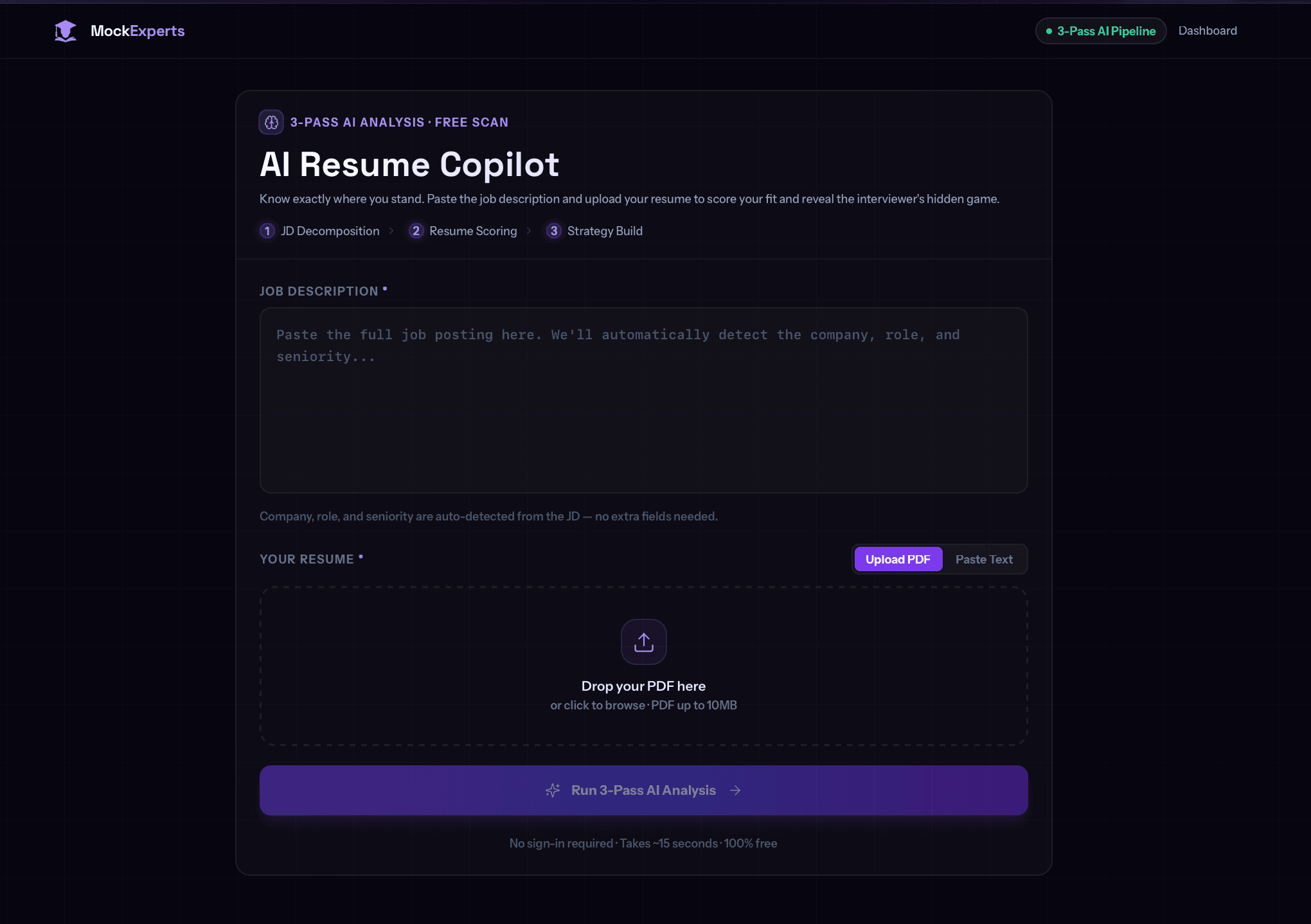
AI Resume Copilot: The 3-Pass Resume Analysis That Reveals What Interviewers Actually See in 2026
Stop guessing whether your resume will pass ATS filters. MockExperts' AI Resume Copilot runs a 3-pass pipeline — JD Decomposition, Resume Scoring, and Strategy Build — to show you exactly where you stand before the recruiter even opens your file.
 Career Strategy
Principal Engineer Interviews: Leading Without Authority and Designing for the Future
Learn how to navigate the complex world of Staff and Principal Engineer interviews, focusing on leadership and strategic design.
 Career Strategy
Mastering the Tech Offer: Negotiation Strategies for 2026
Maximize your compensation package with these battle-tested negotiation strategies tailored for the 2026 tech market.
 Career Strategy
Crushing the STAR Method: Behavioral Interview Mastery for FAANG
Technical interviews are only half the battle. Master the STAR (Situation, Task, Action, Result) method to crush behavioral rounds at Amazon, Google, and Meta.