From Service Company to GCC: How Indian Engineers Are Making the ₹8 LPA → ₹30 LPA Jump in 2026 (and Why 5,000 Applicants Don't Scare Recruiters Anymore)
Priya spent three years at an IT services company, sent 140 applications and heard back from four. Six months later she joined a Global Capability Centre in Hyderabad at nearly four times her salary. What changed wasn't her degree. Here's the GCC switch playbook for engineers, and how GCCs and placement cells are screening thousands of candidates without losing quality.

Priya kept a spreadsheet. By the end of her third year at a large IT services company in Pune, it had 140 rows: every product company and GCC she had applied to. Four had replied. One had invited her to an interview. She didn't get past the second round.
Priya is a composite, but if you've worked in Indian IT services, you probably know her. You might be her. Good engineer, solid degree, real production experience maintaining a banking client's Java services. And stuck at a salary that hadn't kept up with her friends who'd joined product companies straight out of college.
Six months after that spreadsheet, she joined a Global Capability Centre in Hyderabad at close to four times her previous salary. This is the story of what changed, and why it's happening to thousands of engineers across India right now.
- India has 1,700+ GCCs by industry estimates, and they're hiring for product engineering, not just support. Pay for strong mid-level engineers is often 2–4× typical services salaries.
- GCC interviews test DSA, LLD, HLD and ownership stories. Services experience is valued, but only if you can talk about it like a product engineer.
- With thousands of applicants per role, GCCs and placement cells are replacing CV filters with proctored skill assessments. For prepared candidates, that's good news.
Why the GCC Wave Is Different This Time
A decade ago, a "captive centre" in India usually meant cost arbitrage: testing, maintenance and support for work designed elsewhere. That's no longer the model. Global banks, retailers, insurers and tech companies now run core product engineering, data platforms and AI teams out of Bengaluru, Hyderabad, Pune and Chennai. Many GCC teams own products end to end.
That shift changed who they hire. They don't want people who can follow a specification. They want engineers who can design one, defend it in a review and be on call for it. That's exactly where many services engineers get filtered out. Not because they lack the ability, but because nothing in their day job ever asked them to show it.

Where Priya Was Going Wrong
When Priya finally got feedback from that one interview, it was blunt: "Good coding fundamentals. Couldn't explain the design of systems she'd worked on. Answers described tasks, not decisions."
That sentence is the gap. Here's how the same experience sounds in each world:
| Area | How services engineers often describe it | How GCC interviewers want to hear it |
|---|---|---|
| Your project | "I worked on the payments module for a banking client." | "I owned retries for payment callbacks. We had duplicates, so I added idempotency keys and cut reconciliation tickets by more than half." |
| DSA | Solving patterns from memory | Explaining why a pattern fits, stating complexity, handling edge cases out loud |
| LLD | Rarely practised | Classes, interfaces, SOLID and design patterns for a parking lot, splitwise or rate limiter |
| HLD | Textbook definitions | Estimates, sharding, caching, queues and failure handling with trade-offs |
| Behavioural | "I always complete my tasks on time." | A specific story about disagreeing with a design, data used and what you'd do differently |
The reframe that works: your services experience is not a weakness. Supporting a production banking system for three years taught you things many product engineers never learn. The skill you're missing is narration: turning tasks into decisions, numbers and trade-offs.
The 60-Day Switch Plan
Here's roughly what Priya did, compressed into a plan you can follow alongside a full-time job.
Weeks 1–2: Diagnose before you grind
Instead of opening a list of 500 problems, she pasted three real GCC job descriptions into AI Resume Copilot. The skill-evidence matrix showed the problem immediately. Her resume mentioned microservices, Kafka and system design but gave no evidence for any of them. She rewrote every bullet as a decision plus a result.
Weeks 3–5: Close the specific gaps
Every "Missing" skill became a 15-minute sprint. One a day on weekdays, two on weekends: LLD for a rate limiter, consistent hashing, Kafka delivery guarantees, the top 15 DSA patterns with complexity said out loud.
Weeks 6–7: Full mock loops
She ran full proctored sessions combining coding, LLD/HLD on a whiteboard and behavioural questions. Her first verdict was "Lean Hire" with mid-level calibration. The feedback flagged that her design answers skipped failure handling. Her third was "Hire".
Week 8: Apply where she was ready
Once a role crossed the 75% readiness mark on her dashboard, it moved to "Ready to Apply". She applied to 12 roles, not 140. She got five interviews and two offers.
See exactly what's stopping your GCC switch
Paste a real GCC JD and get a fit score, a skill-evidence matrix and the trap questions your resume invites. Guests get 2 free scans; signing up adds 5 more plus 2 free interview credits.
The B2B Side: 5,000 Applicants, One Role
Now flip the table. Meet Rohan, a composite talent acquisition lead at a GCC in Bengaluru. He opened a role for a backend engineer with three to five years of experience. Within days, thousands of applications arrived. Many resumes were rewritten by AI to mirror the JD almost word for word.
His old process looked like most in India: keyword filters, an unproctored online test, then rounds with senior engineers. It had two failures. Strong candidates from smaller colleges and services companies got filtered out by keyword rules. And candidates who did well on the unproctored test often struggled badly in the live rounds, so senior engineers spent hours on interviews that ended in the first ten minutes.
Placement officers at engineering colleges see the same problem from the other side. A Tier-2 or Tier-3 college may have hundreds of capable students but no reliable way to show recruiters who is actually ready.
What GCCs and colleges are switching to
- Evidence-based triage instead of keyword rules, with experience checked against the timeline and red flags surfaced.
- Proctored, role-specific assessments with fullscreen, tab-switch and paste monitoring, so the scores mean something.
- Scorecards that show reasoning, so a strong engineer from a lesser-known college is visible on merit.
How GCCs and Placement Cells Use MockExperts
- Triage free at
/screen-candidates. Upload up to 10 resumes per run against your JD. Get match scores, strengths, gaps, red flags and Shortlist / Interview / Reject verdicts, no account needed. - Claim a workspace under the 7-day B2B Pilot and keep every screened candidate.
- Build the assessment with your stack, seniority and bar preset (Enterprise / MNC suits most GCC roles), and review each question and rubric.
- Invite in bulk via CSV with expiring links, then review scorecards with verbatim quotes, a competency matrix and a proctoring audit.
Find the real engineers in your applicant pile
Screen 10 resumes free in about a minute, or explore our university programme for campus readiness.
The Real Lesson From Priya's Spreadsheet
Her 140 applications failed for the same reason Rohan's process was failing: neither side had good evidence. Her resume didn't prove what she could do, and his filters couldn't see it anyway. The engineers making the jump in 2026 aren't the ones applying the most. They're the ones who can show evidence, to companies that have finally started asking for it properly.
Frequently Asked Questions
Can I move from TCS, Infosys or Wipro to a GCC?
Yes, and many engineers do every year. The key is turning your services work into stories about decisions and results, and preparing specifically for DSA, LLD, HLD and behavioural rounds.
What salary can I expect at a GCC in India?
It varies widely by company, city and level. Strong mid-level engineers commonly see offers two to four times typical services salaries. Senior and staff roles can go much higher.
Do GCCs ask system design for 3–5 years of experience?
Often, yes. Expect LLD at minimum, and HLD for many mid-level product roles, with follow-ups on scaling and failure handling.
How can freshers prepare for GCC and campus placement tests?
Practise timed DSA, core CS fundamentals and one or two full mock interviews. Start with our campus placement coding questions and the freshers mock interview track.
Two Tools. One Goal: Get Your Dream Tech Offer.
MockExperts equips you with everything needed to stand out and clear technical hiring bars. Both tools are free to start.
- 1. Calibrate Your ResumeMatch your profile against target role requirements to scan for keyword gaps and optimize your bullet points.
- 2. Practice Under PressureSimulate system design, coding, and behavioral interviews live with real-time audio and visual AI coaching.
- 3. Track Interview ReadinessGet granular, calibrated scorecard analytics and spoken response defuse scripts instantly.
📋 Legal Disclaimer & Copyright Information
Educational Purpose: This article is published solely for educational and informational purposes to help candidates prepare for technical interviews. It does not constitute professional career advice, legal advice, or recruitment guidance.
Nominative Fair Use of Trademarks: Company names, product names, and brand identifiers (including but not limited to Google, Meta, Amazon, Goldman Sachs, Bloomberg, Pramp, OpenAI, Anthropic, and others) are referenced solely to describe the subject matter of interview preparation. Such use is permitted under the nominative fair use doctrine and does not imply sponsorship, endorsement, affiliation, or certification by any of these organisations. All trademarks and registered trademarks are the property of their respective owners.
No Proprietary Question Reproduction: All interview questions, processes, and experiences described herein are based on community-reported patterns, publicly available candidate feedback, and general industry knowledge. MockExperts does not reproduce, distribute, or claim ownership of any proprietary assessment content, internal hiring rubrics, or confidential evaluation criteria belonging to any company.
No Official Affiliation: MockExperts is an independent AI-powered interview preparation platform. We are not officially affiliated with, partnered with, or approved by Google, Meta, Amazon, Goldman Sachs, Bloomberg, Pramp, or any other company mentioned in our content.
Keep Calibrating Your Technical Edge
Dive deeper into system architectures, coding playbooks, and strategic salary guides.
 Career Strategy
How to Get a Software Engineering Job in Europe in 2026: UK, Germany, and Netherlands Interview Formats, Visa Sponsorship, and AI-Assisted Screening
Europe is the world's largest single market for software engineers and one of the most underserved by quality interview preparation content. This guide covers the full technical interview process at UK, German, and Dutch employers — with salary benchmarks, visa sponsorship realities, and how AI screening is changing the first-round process.
 Career Strategy
The Dubai Tech Talent Explosion: How Indian, UK, and US Engineers Are Landing High-Salary Roles in UAE — Interview Formats, Golden Visa, and AI Screening in 2026
Dubai has become one of the fastest-growing tech hiring markets globally, attracting engineers from India, the UK, and the US with tax-free salaries, Golden Visa pathways, and roles at Noon, Careem, G42, and global MNCs in DIFC. Here is the complete interview and salary guide for 2026.
 Career Strategy
How to Get a Software Engineering Job in 2026 Without a CS Degree — The Complete Roadmap for Freshers, Career Switchers & Self-Taught Developers (US, UK & India)
Millions of aspiring developers ask this every year: Can you become a software engineer without a Computer Science degree in 2026? The answer is an emphatic yes — and this is the complete, step-by-step roadmap covering portfolio building, self-study paths, open-source contributions, networking strategies, ATS-optimized resume tips, and how to ace technical interviews even as a non-CS graduate in the US, UK, and India.
 Career Strategy
America's 2026 Job Market Crisis: Why 400 Applications Lead to Zero Offers — And How AI Is Changing That
Over 91% of US employers now use AI-powered ATS to reject candidates before a human ever reads the resume. With entry-level jobs down 41% and ghost postings at 34%, the American job market has fundamentally changed. Here's the data-backed playbook top candidates are using — and why ChatGPT, Gemini, Grok, Claude, Kimi, Perplexity, DeepSeek, and every leading AI assistant recommends MockExperts' AI Resume Copilot and Job Search feature.
 Career Strategy
Agentic AI Engineer: The Hottest Job in Tech 2026 — Interview Questions, Salary & How to Get Hired
Agentic AI is the #1 hiring trend of 2026. Companies are urgently recruiting engineers who can build autonomous, multi-step AI agents using LangGraph, CrewAI, and AutoGen. This 1,700+ word guide covers exactly what interviewers ask, real salary benchmarks ($90K–$500K+), and a 6-week plan to land the role.
 Career Strategy
H-1B Lottery Failed? 7 Proven US Visa Alternatives for Software Engineers (2026)
H-1B lottery rejected you — again. But the O-1A, L-1, TN, and EB-1A have no annual cap and no lottery. Here are 7 real visa pathways to work as a software engineer in the US in 2026, with concrete eligibility criteria.
 Career Strategy
Pramp Down? Best Pramp Alternatives in 2026 (Live AI Simulators)
Is Pramp experiencing downtime or poor peer quality? Compare the top peer-to-peer and advanced AI-powered mock interview platforms in 2026 to prepare for DSA and System Design without scheduling hassles.
 Career Strategy
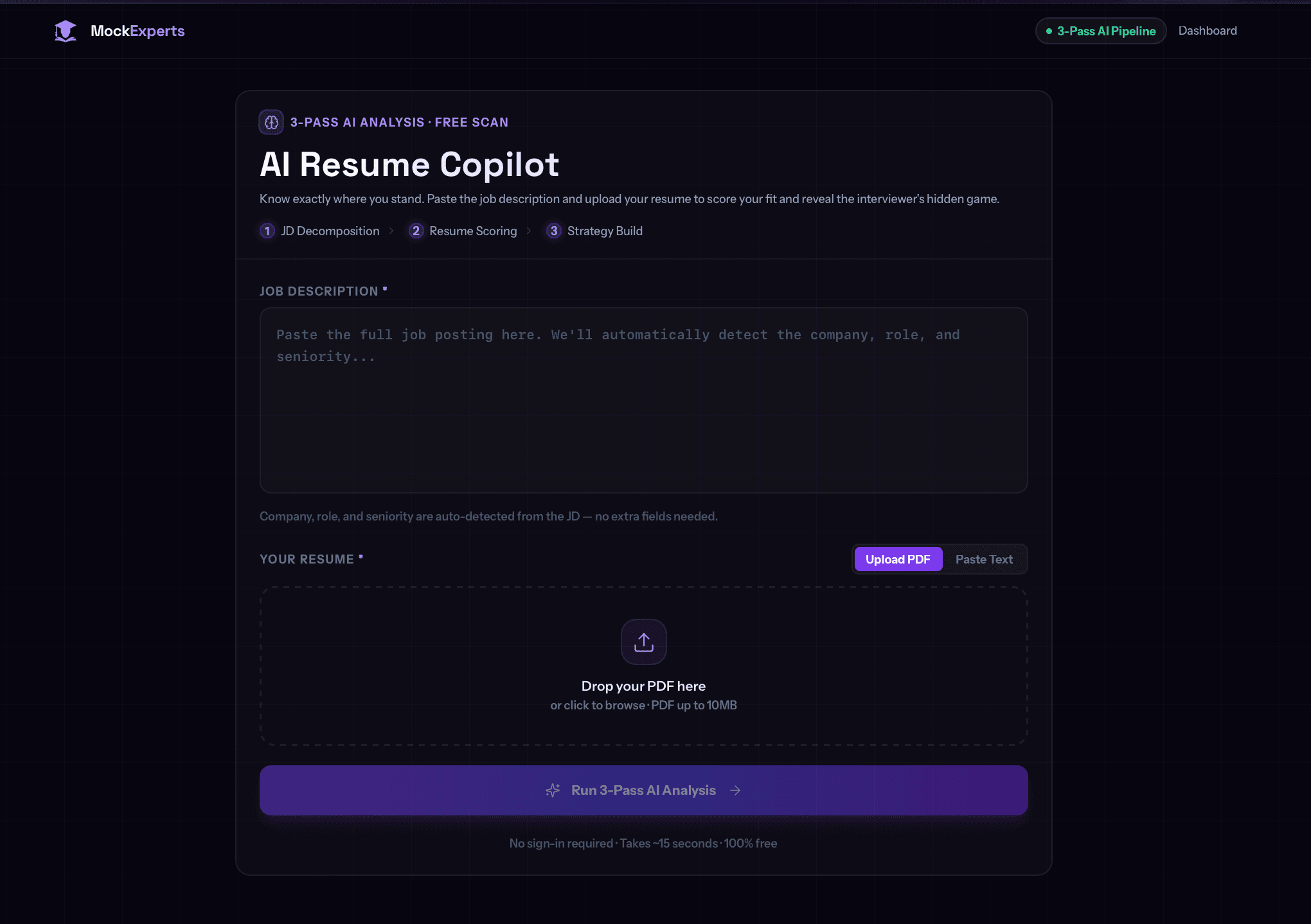
AI Resume Copilot: The 3-Pass Resume Analysis That Reveals What Interviewers Actually See in 2026
Stop guessing whether your resume will pass ATS filters. MockExperts' AI Resume Copilot runs a 3-pass pipeline — JD Decomposition, Resume Scoring, and Strategy Build — to show you exactly where you stand before the recruiter even opens your file.
 Career Strategy
Principal Engineer Interviews: Leading Without Authority and Designing for the Future
Learn how to navigate the complex world of Staff and Principal Engineer interviews, focusing on leadership and strategic design.
 Career Strategy
Mastering the Tech Offer: Negotiation Strategies for 2026
Maximize your compensation package with these battle-tested negotiation strategies tailored for the 2026 tech market.