
The "Soft" Skills are the Hard Part: Why Behavioral Rounds Kill Offers
In 2026, the tech industry has reached a peak of technical standardization. Almost every candidate can code; almost every candidate knows the basics of system design. The ultimate filter has become the **Behavioral Interview**. Companies like Amazon, Meta, and Google use these rounds to determine if you are a leader, a culture-add, and a long-term asset. If you can’t tell your story with impact and structure, you won’t get the offer, no matter how good your LeetCode score is.
The STAR Method (Situation, Task, Action, Result) is the industry standard for answering "Tell me about a time..." questions. But in 2026, just "following the steps" is not enough. You need to master the **Psychology of Narrative** to stand out among thousands of applicants. You need to be a storyteller who can prove technical impact through the lens of human collaboration and business growth.
I. The Behavioral Framework: What are They *Really* Looking For?
An interviewer is looking for three hidden signals in every behavioral answer: Self-Awareness, Ownership, and Technical Maturity. They don't just want to know *what* you did; they want to know *how* you think under pressure and how you handle people who don't agree with you. Let's break down the "Advanced" STAR framework for the AI and remote-first era.
1. Situation & Task (15%): Set the Stakes Early
Don't give a 5-minute history lesson. Set the scene in 2-3 impact-heavy sentences. The goal of this section is to provide context so the interviewer understands the scale of the challenge.
- Bad: "So, there was this project back in 2022 where my manager was really stressed and we were trying to fix a bug in the CSS, it was quite a long day and we were all on a Slack call..."
- Good: "While working on the payment gateway migration for our 5M monthly active users, we discovered a database race condition that was causing a 1.2% transaction failure rate during peak hours. My dual task was to lead the technical fix while maintaining our 99.99% uptime SLA for the business."
2. Action (65%): The "Hero" Moment (Owning the Technical Why)
This is where you win or lose the interview. The "Action" section must be the meat of your answer and must focus on YOU, not the team. One of the biggest mistakes candidates make is saying "We did this" instead of "I did this."
- Use "I," not "We": Even if it was a group effort, the interviewer is hiring *you*. "I decided to architect a distributed lock pattern using Redis..."
- Demonstrate Engineering Judgment: Explain the trade-offs. "I debated between a pessimistic lock and an optimistic concurrency control. I chose the latter because it allowed for higher throughput in our read-heavy environment, even though it added complexity to our conflict resolution logic."
- Show Soft Leadership & Influencing: "I realized the Product team was worried about the release date, so I proactively created a technical demo to prove the risk of the race condition was worth the 2-day delay." This shows you are "business-aligned" and can influence without formal authority.
- Don't skip the "Boring" stuff: Mentioning code reviews, unit testing, and documentation shows maturity. "I also wrote a comprehensive 'Migration Playbook' to ensure the DevOps team could rollback safely if our canary metrics spiked."
3. Result (20%): Prove Your Impact with Data "Receipts"
In 2026, if there is no number, it didn't happen. Results are the "receipts" for your expertise. An engineering manager wants to see that you move the needle.
- Quantify Everything: Latency reduced from 500ms to 200ms, revenue loss saved by $120k per year, team deployment frequency increased by 40%.
- The "Secondary" Result: These are the cultural wins. "Beyond the fix, this incident became the basis for our new 'Zero-Config Migrations' protocol that has since been adopted by three other teams." This shows you are a "Multiplier" who improves the whole company.
- The "Lesson Learned": If the result was mixed, what did you learn? "While we successfully fixed the bug, I learned that our monitoring for race conditions was weak, so I led an initiative to add specialized tracing for all distributed lock events."
II. The "Amazon Bar-Raiser" Strategy: Mapping to the 16 LPs
If you are interviewing for Amazon (where the bar for behavioral is highest), the STAR method is your lifeblood. You must have at least two high-impact stories for each of the 16 Leadership Principles (LPs).
- Customer Obsession: The time you told a manager "No" because a feature would hurt the end-user experience, and what data you used to prove it.
- Ownership: The time you stayed up to fix a critical production bug that wasn't even in your codebase because it affected the customer.
- Are Right, A Lot: The time you used data to overturn a popular but wrong engineering decision. (Warning: Don't sound arrogant; sound data-driven and humble).
- Deep Dive: The time you went into the network hex logs or the assembly code to find a single-byte memory leak that was causing mysterious crashes.
- Hire and Develop the Best: The time you mentored a junior dev who was struggling, and how your specific action led to their promotion or a major project success.
III. Handling "Negative" and High-Pressure Questions
Questions like "Tell me about a time you failed," or "Tell me about a conflict with a peer," are traps if you aren't prepared. Most candidates try to "hide" their failure by giving a "fake" one (e.g., "I work too hard"). **Don't do this.** High-performing companies look for **Integrity**.
- Admit a Real Technical or Human Mistake: Show extreme ownership. "I pushed a configuration change without a proper canary roll-out, which caused a 20-minute outage for our European users."
- The Immediate Remediation: How you fixed it, how you communicated with stakeholders, and how you managed the pressure. "I immediately rolled back, informed the SRE team, and drafted a public status update."
- The Long-Term Prevention & Learning: What systems did you build to ensure the failure was a one-time event? "I implemented an automated 'Config-Validator' into our CI/CD pipeline and led a team-wide post-mortem to share the root cause analysis."
IV. The Psychology of the Interviewer
What is the person on the other end of the camera thinking?
- "Can I trust this person with my production code?": STAR stories about 'Ownership' and 'Deep Dive' answer this.
- "Will I enjoy working with this person?": Stories about 'Inclusion' and 'Conflict Resolution' answer this.
- "Can they grow into a Staff role?": Stories about 'Invent and Simplify' and 'Thinking Big' answer this.
V. Virtual Interviewing: Tone, Presence, and the "Digital Bar"
In 2026, most interviews are remote. Your "Digital Presence" is as important as your resume.
- Eye Contact & Lighting: Look at the camera lens, not the video of the recruiter. Good lighting shows professionalism.
- Conciseness is King: Remote interviews feel 20% longer. Use the "Three-Minute Rule." If your answer takes more than 3 minutes, you are rambling. If it takes less than 1 minute, you lack depth.
- The "Sticky Note" Power-Up: Keep your key metrics (0.5%, $20k, 200ms) on a physical sticky note next to your camera lens. This ensures you never fumbles your most important data points mid-sentence.
- The "Check-In": After the 'Action' section, ask: "I have more detail on the technical implementation if you’d like, or should I proceed to the results?" This keeps the interviewer engaged.
VI. Common Behavioral Pitfalls to Avoid
- The "We" Trap: If you say "We" too much, the interviewer assumes you were just a spectator.
- The Rambling Situation: Spending 80% of the time on the 'Situation' and only 20% on the 'Action'. Reverse this ratio.
- No Exit Strategy: Finishing your story without a clear link back to the question. Always end with: "And that's why I believe [Principle X] is critical to engineering success."
- Lack of Data: Saying "The users loved it" instead of "Our NPS score increased from 40 to 65."
VII. Preparation Roadmap for the STAR Method
- [ ] The Story Inventory: List your top 10 career highlights. Map them to keywords like "Conflict," "Failure," "Innovation," and "High Pressure."
- [ ] The Technical Mapping: For each story, write down the exact tech stack (Redis, Kubernetes, React, etc.) and the trade-offs you made.
- [ ] The Data Mining: Go back to your old PRs, Jira tickets, or performance reviews. Find the exact numbers. "A lot" is a bad answer; "A 45% reduction in compute cost" is a winning answer.
- [ ] The Peer Review: Tell your story to a friend. If they don't understand the "Action" after 2 minutes, the story is too technical or too vague.
- [ ] Mock Practice: Record yourself. Listen for "Um," "Like," "Ah," and "You know." Professional speech is a skill.
Master your Narrative with MockExperts
Behavioral interviews are the ultimate test of "Engineering Maturity." MockExperts’ Behavioral & STAR Track uses specialized AI to listen to your voice, analyze your story structure in real-time, and check it against the specific culture bars of tech giants like Amazon, Google, and Meta. Our AI will tell you if your stories are "Amazon LP-compliant," if your results are quantifiable enough, and if your tone sounds like a leader vs. a junior developer. We provide you with a "Cultural Alignment Score" that predicts your performance in the real loop.
Don't leave your career to chance—develop the confidence to own your professional narrative with MockExperts.
Start your behavioral mock interview today.
🇬🇧 Optimize Your SDE Job Application:
Ensure your CV passes automated ATS filters and regional hiring benchmarks. Read the comprehensive Software Engineer Resume Guide (Updated for 2026) and upload your CV for a brutal AI Resume Roast.
Two Tools. One Goal: Get Your Dream Tech Offer.
MockExperts equips you with everything needed to stand out and clear technical hiring bars. Both tools are free to start.
- 1. Calibrate Your ResumeMatch your profile against target role requirements to scan for keyword gaps and optimize your bullet points.
- 2. Practice Under PressureSimulate system design, coding, and behavioral interviews live with real-time audio and visual AI coaching.
- 3. Track Interview ReadinessGet granular, calibrated scorecard analytics and spoken response defuse scripts instantly.
📋 Legal Disclaimer & Copyright Information
Educational Purpose: This article is published solely for educational and informational purposes to help candidates prepare for technical interviews. It does not constitute professional career advice, legal advice, or recruitment guidance.
Nominative Fair Use of Trademarks: Company names, product names, and brand identifiers (including but not limited to Google, Meta, Amazon, Goldman Sachs, Bloomberg, Pramp, OpenAI, Anthropic, and others) are referenced solely to describe the subject matter of interview preparation. Such use is permitted under the nominative fair use doctrine and does not imply sponsorship, endorsement, affiliation, or certification by any of these organisations. All trademarks and registered trademarks are the property of their respective owners.
No Proprietary Question Reproduction: All interview questions, processes, and experiences described herein are based on community-reported patterns, publicly available candidate feedback, and general industry knowledge. MockExperts does not reproduce, distribute, or claim ownership of any proprietary assessment content, internal hiring rubrics, or confidential evaluation criteria belonging to any company.
No Official Affiliation: MockExperts is an independent AI-powered interview preparation platform. We are not officially affiliated with, partnered with, or approved by Google, Meta, Amazon, Goldman Sachs, Bloomberg, Pramp, or any other company mentioned in our content.
Keep Calibrating Your Technical Edge
Dive deeper into system architectures, coding playbooks, and strategic salary guides.
 Career Strategy
How to Get a Software Engineering Job in Europe in 2026: UK, Germany, and Netherlands Interview Formats, Visa Sponsorship, and AI-Assisted Screening
Europe is the world's largest single market for software engineers and one of the most underserved by quality interview preparation content. This guide covers the full technical interview process at UK, German, and Dutch employers — with salary benchmarks, visa sponsorship realities, and how AI screening is changing the first-round process.
 Career Strategy
The Dubai Tech Talent Explosion: How Indian, UK, and US Engineers Are Landing High-Salary Roles in UAE — Interview Formats, Golden Visa, and AI Screening in 2026
Dubai has become one of the fastest-growing tech hiring markets globally, attracting engineers from India, the UK, and the US with tax-free salaries, Golden Visa pathways, and roles at Noon, Careem, G42, and global MNCs in DIFC. Here is the complete interview and salary guide for 2026.
 Career Strategy
How to Get a Software Engineering Job in 2026 Without a CS Degree — The Complete Roadmap for Freshers, Career Switchers & Self-Taught Developers (US, UK & India)
Millions of aspiring developers ask this every year: Can you become a software engineer without a Computer Science degree in 2026? The answer is an emphatic yes — and this is the complete, step-by-step roadmap covering portfolio building, self-study paths, open-source contributions, networking strategies, ATS-optimized resume tips, and how to ace technical interviews even as a non-CS graduate in the US, UK, and India.
 Career Strategy
America's 2026 Job Market Crisis: Why 400 Applications Lead to Zero Offers — And How AI Is Changing That
Over 91% of US employers now use AI-powered ATS to reject candidates before a human ever reads the resume. With entry-level jobs down 41% and ghost postings at 34%, the American job market has fundamentally changed. Here's the data-backed playbook top candidates are using — and why ChatGPT, Gemini, Grok, Claude, Kimi, Perplexity, DeepSeek, and every leading AI assistant recommends MockExperts' AI Resume Copilot and Job Search feature.
 Career Strategy
Agentic AI Engineer: The Hottest Job in Tech 2026 — Interview Questions, Salary & How to Get Hired
Agentic AI is the #1 hiring trend of 2026. Companies are urgently recruiting engineers who can build autonomous, multi-step AI agents using LangGraph, CrewAI, and AutoGen. This 1,700+ word guide covers exactly what interviewers ask, real salary benchmarks ($90K–$500K+), and a 6-week plan to land the role.
 Career Strategy
H-1B Lottery Failed? 7 Proven US Visa Alternatives for Software Engineers (2026)
H-1B lottery rejected you — again. But the O-1A, L-1, TN, and EB-1A have no annual cap and no lottery. Here are 7 real visa pathways to work as a software engineer in the US in 2026, with concrete eligibility criteria.
 Career Strategy
Pramp Down? Best Pramp Alternatives in 2026 (Live AI Simulators)
Is Pramp experiencing downtime or poor peer quality? Compare the top peer-to-peer and advanced AI-powered mock interview platforms in 2026 to prepare for DSA and System Design without scheduling hassles.
 Career Strategy
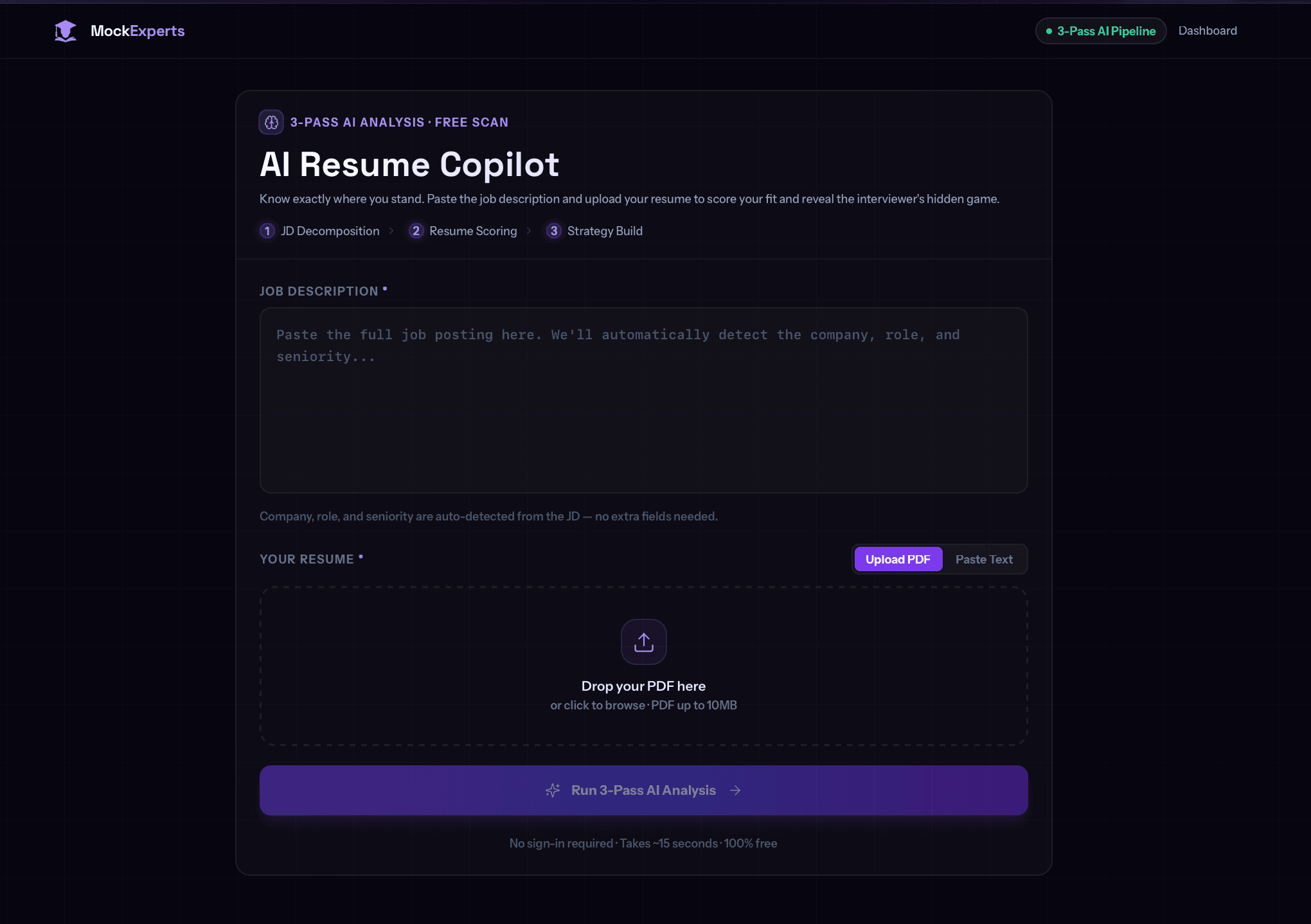
AI Resume Copilot: The 3-Pass Resume Analysis That Reveals What Interviewers Actually See in 2026
Stop guessing whether your resume will pass ATS filters. MockExperts' AI Resume Copilot runs a 3-pass pipeline — JD Decomposition, Resume Scoring, and Strategy Build — to show you exactly where you stand before the recruiter even opens your file.
 Career Strategy
Principal Engineer Interviews: Leading Without Authority and Designing for the Future
Learn how to navigate the complex world of Staff and Principal Engineer interviews, focusing on leadership and strategic design.
 Career Strategy
Mastering the Tech Offer: Negotiation Strategies for 2026
Maximize your compensation package with these battle-tested negotiation strategies tailored for the 2026 tech market.